A place for Lizzie Fragale, the technology teacher coach at River Eves Elementary school, to write app reviews, provide web resources, and any other pertinent information.
This month, I have been a part of numerous teachers forays into the world of iMovie, an easy to use, convenient, AMAZING app that is loaded onto all of our student iPads.
What is iMOVIE?
According to Apple's website, "iMovie.. lets you enjoy your videos like never before. Browse your clips more easily, instantly share your favorite moments, and create beautiful HD movies and Hollywood‑style trailers. And when you’re ready to premiere on all your devices, iMovie Theater rolls out the red carpet." And this information is all completely legit - our students are creating movies to demonstrate learning, to teach peers, to address a concern they have, and these movies look like Hollywood productions! See this page for an example: STEM Video Padlet
How can I use iMOVIE? Basic instructions and ideas of what you can do with this app can be found at the following link: Knowing What You Can Do with iMovie
Teachers and support staff here at River Eves had a blast at this year's Georgia Educational Technology Conference (GaETC). The three day event served as a fantastic resources for lesson plans, gadgets, apps, websites - all things school tech related. We are so thankful for Fulton county's Vanguard committee, the school, and our wonderful education foundation (REEF) for supporting us in our pursuit of further knowledge and professional development. Below, you will find some pictures from the event. Enjoy!
Good morning, River Eves! This month has been an exciting month back in the classroom. And our teachers and I have fallen in love with the web resource PADLET. I began taking advantage of the awesome features that Padlet offers at the end of the previous school year when we used it for our "So You Think You Can Hip-Hop Dance" PE lesson. Below, you will find the "Fragale 5" as an introduction to this amazing Technology Treasure. Enjoy!
1. What? (A brief overview of what the resource does)
In the words of Shaun Takenouchi, "When you first start to use Padlet you have a blank page where you can do a variety of things. You can drag and drop documents, images, and PDF’s from your desktop to your wall. You can also copy and paste links to videos or websites as well as use your computer’s (or tablet's) camera to take a picture to put up. Lastly, you have the option to just start typing on your page and create notes on it." When it comes to privacy on a Padlet, the teacher can make a page public, password protected, or completely private. In regards to sharing a link to a page, Padlet even creates a unique QR code for you - eliminating that extra step! It is also important to note that Padlet is a WEB resource, not an app. Therefore, it is accessible on any device with internet access.
2. Who? (Audience, which grade levels can really benefit from this resource?)
All grade levels can benefit from using Padlet, even all subject areas. Because it is a quick and easy website creator that pairs well with iPads, the possibilities are endless in our school!
3. Where? (In what learning context would this resource be relevant?)
This resource would really work in all classrooms. A teacher could you Padlet to provide students with a WebQuest, a research assignment, in Social Studies (see below in 4th Humanities classes):
A teacher could use Padlet as a password protected writing portfolio for collaboration and peer feedback (see below in Ms. Dearborn's class):
A teacher could use Padlet as a ticket out the door or reflection piece of some sort (see below in Ms. Newton's first grade class - I know Ms. Schechter has used this in her ELA class as well!):
A teacher could use Padlet to track student progress in writing, speaking, really any skill. AND the beauty of Padlet is this can be shared with parents, relatives, any person who has the password. Those individuals have the option to leave feedback too! (see below in Ms. Donnell's Kindergarten class):
A teacher could take a video of herself in the classroom teaching, reviewing, introducing a topic, anything, and easily share this video with the class, even the world (see below in Ms. Moss's video introduction):
4. Why? (How can this REALLY help me?)
Padlet is fantastic because it eliminates unnecessary steps while communicating and collaborating with others. As teachers, we want to meet the needs of all learners, and the idea of blended learning and the flipped classroom become more attainable with a fantastic resource like Padlet.
First graders working on literary response entries; some type their sentences while other take a picture to post of their written word.
5. How? (Basic Instructions) For basic usage directions, follow the link below! I hope you enjoy getting acquainted with the wonderful web resource Padlet. How to Use Padlet
It's your Technology Teacher Coach, Ms. Lizzie Fragale, here, and I am very excited for the year ahead! I am thrilled to be back and happy to report that we are off to a fantastic technology start. We are SO excited to have a STEM lab in our school with a great teacher, Ms. Ally Baker. Ms. Baker and I have already been planning and researching to make this unique opportunity truly special for our kids.
In other news, Kindergarten teachers (and other grades) have been using the wonderful web resource Padlet to create student portfolios for their work to track their progress in the classroom. Padlet makes uploading videos and pictures from the iPad EASY and includes special features like QR codes and password protected sites.
Additionally, I have enjoyed getting to know our new Media Specialist, Ms. Neubauer, and we have already collaborated on a great lesson for our third graders - I just love watching these kids take the technology to research and create something special (I even get to learn a thing or two about our National Parks).
Furthermore, the grade-level iPads and BYOT program have empowered teachers to give students access to technology and the possibilities that go along with the devices. For example, 4th grade humanities teachers worked with me to create a WebQuest where students learned more about the Indigenous People of our country. Second grade teacher Ms. Schechter created a "Choice Board" for students as they learned about characterization - her kids loved the refresher course I provided on using Educreations - so pumped up about learning!
Though I have only been back for two weeks, I am quite impressed with this amazing school. From teacher QR codes to iPad centers, it's incredible to watch how our staff has really stepped it up with technology. I look forward to a GREAT year ahead!
Happy summer, River Eves! I hope this post finds you excitedly looking forward to our summer vacation. To prepare you for the upcoming months, I have created two lists. The first is a list of apps that will engage our students during the summer months while still challenging them academically. The second is a list of web resources that perform the same tasks. I call these resources....
[undercover] learning
My Top 5 Summer Learning Apps
Mad Libs - test their grammar skills and create super funny stories in the process - it's an oldie but a goodie to me.
Sushi Monster - this monster is hungry for sushi - answer the math questions correctly and keep him fed!
Brain Pop - App that provides students with education videos on a WIDE variety of topics and even includes supplemental information, quizzes, links, etc. Many teachers use this already, and kids LOVE it!
MoMA Art Lab - App from the Museum of Modern Art that allows students to create their own masterpieces, learn more about famous artists, even create sound compositions and shape poems!
Wonderopolis (This Day in History) -So, the last app is actually two apps because I couldn't choose which one was better and they somewhat work together. An easy idea I had to get kids learning every day, is to share these two apps as they provide information on a daily basis. Wonderopolis answers a question (or wonder) of the day with video, pictures, etc. This Day in History gives students just that - a list of events that happened on that day. Perhaps a good first thing in the morning activity while eating breakfast or a way to spark dinner conversation!
My Top 5 Summer Learning Websites
Wonderopolis (web component - see above for more information)
Brainpop (web component - see above for more information)
Free Rice - began as a tool to learn new vocabulary but has now expanded to include many different subject areas (math, science, social studies, even SAT prep!). The cool thing about this website is that for every answer your students gets correct, the website donates 10 grains of rice to the United Nations World Food Programme! So you can talk about physical science AND philanthropy!
Scholastic Family Playground - website that includes games, videos, puzzles, etc. for Scholastic books and programs like 'I Spy,' 'Clifford,' and 'The Magic Schoolbus.' The English teacher in me LOVES the fact that there are online stories as well.
Funbrain - website that includes word and math games, interactive online texts (even web version of 'Diary of a Wimpy Kid'), and some less academic online games as well. I feel that with some parental supervision, this could really be a great online resource for those stormy summer days.
*Another thought: Your students have really become masters of Educreations and (some classrooms only) iMovie. These apps are more creative, like a blank canvas for our kids to create a video/presentation all their own. I would encourage students to chronicle their vacation - from airplane rides, road trips, even day by day activities. These apps are FANTASTIC for letting your student express him or herself in a truly unique way.
This week, fourth grade will be dancing in the gymnasium! It is "So You Think You Can HIP-HOP Dance" week in PE, and we are blending PE, Technology, and Dance to create a unique, interactive lesson that will get our 4th graders moving. Use the links below to help you research, explore, document, and present your project. Good luck!
STEP ONE: Research - Visit each of the links listed below to create FIVE FACTS you learned about Hip-Hop Dance.
STEP TWO: Explore - Watch the following video that gives you a choreographed dance to Pharrell Williams' song "Happy." Pay close attention and get into it - this is the dance you need to learn! Every group member must be up and dancing.
*The BEST dancer from each group will be asked to film your group's dance routine.
STEP THREE: Document - Now that everyone in your group has mastered the "Happy" dance, it is your time to film. The assigned group member will be in charge of using the camera feature on the iPad to film the group dancing to the song. We will only be filming through the first refrain of the song (until around the 1 minute mark).
STEP FOUR: Present - To document all steps of the process, you will create a Padlet wall. Simply, follow this link, and select "Build a Wall." On this "wall," you can type your five facts about hip-hop and upload your group's video. Be sure to include all group members' names! For an example Padlet wall, you can click here.
And you are finished! Remember to fill out your worksheet that includes the QR Code to this blog and space to take notes on the three websites.
Today, Wednesday, March 5, select 4th grade students will be attending a VIRTUAL field trip to Google Headquarters in California! This field trip, sponsored by Discovery Education, is in support of the Doodle 4 Google contest (find more information about THAT here). This AWESOME opportunity is interactive as students are able to ask the Google Doodlers questions about their job, their doodles, and life at Google. We are all very excited about his opportunity. You can learn more about our field trip and even watch the broadcast at the following link: From Sketches to the Google Homepage
Today's Instructional Technology Committee Meeting will focus on the third NETS standard, "Research and Information Fluency." Below you will find information and notes to help teachers meet this standard. Documentation will be due by the end of February.
The ISTE Standard for Research and Information Fluency (#3) includes the following description:
Students apply digital tools to gather, evaluate, and use information.
Plan strategies to guide inquiry.
Locate, organize, analyze, evaluate, synthesize, and ethically use information from a variety of sources and media
Evaluate and select information sources and digital tools based on the appropriateness to specific tasks
Process data and report results
Most of us teachers will complete some sort of research project with our students at some point in the school year. This is a great way to meet this standard. Below, you will find some FABULOUS resources to help you in the process.
According to their website, "Infotopia is an academic search engine accessing only trusted websites previously selected by librarians, teachers, and library and educational consortia. Infotopia is recommended for students, teachers, and, especially, homeschoolers." This is a great way to minimize those moments where students find inappropriate material by just using google to search.
* iBrainstorm App
The iBrainstorm App is simply a blank canvas that can serve as a way to prewrite and plan essays, projects, etc. You can simply draw with your finger or you can add sticky notes. Once you've completed your brainstorming, you can easily share your plans via email or saving the image as a photo on your device. I really see this as beneficial for upper grades in collaboration and group work.
In my classroom, I was always a big fan of WebQuests as an easy way to meet the research standard on a more regular basis and introduce a new subject matter in a more exciting way. I have since discovered Zunal which is an online WebQuest builder and even better, a source for finding WebQuests that have already been made for you! You can search by grade level (either K-2 or 3-5) AND subject area. I would suggest browsing around to see if one can work for you. Love, LOVE it. Also, listed below, I have three other EASY WebQuest ideas. As an ELA teacher, I get so excited about March and Dr. Seuss's Birthday. Hopefully, you do too :)
Dr. Seuss WebQuest for Non or Early Readers - I was inspired by this link which requires students to simply use Google image as a search engine to match the Seuss character with the appropriate book title. If this seems like something that would be of interest to your class, just let me know, and I can create a worksheet for the kids.
The Rhyming Man: Dr. Seuss and His Books - This WebQuest is already linked to the standards and completely finished for you. The focus of this WebQuest is 1st-3rd Language Arts. It is well-planned but seems like it would need quite a few days to complete the entire project.
Dr. Seuss WebQuest for Older Students - Here is a link to a WebQuest that is already created that looks at the biography of Seuss and has students answer questions. Link: Seuss WebQuest
I am new to Wonderopolis, but I think I am in love. Every day, the site poses an intriguing question and explores it in a variety of ways. According to the website, "with multi-disciplinary content that purposefully aligns to Common Core State Standards (CCSS), the STEM Educational Quality Framework, and Bloom’s Digital Taxonomy, we’ve earned a place in K-12 curriculum and in classrooms worldwide. Teachers can use the daily Wonder to jumpstart their students’ critical thinking, or dip into our ever-growing collection of Wonders for content that relates to specific themes and student interests." There is even an educator resource ( here ) where teachers can search for content based upon common core standards and grade level. *I thought this one would be great for today: http://wonderopolis.org/wonder/have-you-ever-been-in-a-spelling-bee/
My idea for a quick and easy way to incorporate this resource into your classroom would be to have a "Wonder Wednesday" every week where you explore questions the students have or simply open the website and see what the wonder of the day is. Then, you can have authentic conversations with students in which you discuss how to find answers, brainstorm, and even research. Pretty cool!
Here is an example from a teacher's classroom that she uploaded on her Twitter account.
* Evernote
I know that I seem to keep coming back to Evernote, but it is just because I LOVE it. In regards to research, Evernote is a great way to keep track of information and easily share it with classmates, teachers, and parents. A teacher can simply create a folder for each child in which she can take notes, copy links, etc. At the end of the period, these notes are sent to parents or a partner if collaborating, and saved in the Evernote folder. Or if the student has a unique login, she can access her notes from iPad, computer, or any other device with the Evernote app.
If you have any other research resources that you want to share, please send me an email at Fragale@fultonschools.org. Have a great day!
To review this resource, I will give
it the "FRAGALE 5."
1. What? (A brief overview of what the resource does)
According to the
Skype in the Classroom website, Skype is a software that allows you to speak to, see and instant message
other people who have Skype accounts wherever they are in the world. It is an
application you download which allows you to make calls and send messages via
the internet. In the classroom, Skype can be used to collaborate with other
classes, no matter where they are; find guest speakers and invite them into
your classroom; and take a virtual field trip anywhere in the world.
2. Who? (Audience, which grade levels can really benefit from this resource?)
Skype can be used in every classroom. In our school, classes have held “Mystery
Skype” lessons, collaborated across the globe, and even taken a virtual field
trip to the Channel 5 News Studio! This is NOT a resource for only upper grades
– it is really for everyone J
3. Where? (In what learning context would this resource be relevant?)
Below, I have listed some ways to use Skype in the classroom. This is just a
sample of some ways to use the resource, but really the possibilities are
endless!
·“Mystery Skype” - a lesson in geography, research,
and collaboration to determine the location of the class with which you are
Skyping.
·Virtual Field Trip - visit a zoo, museum,
explore oceans, mountains, and faraway places – no money, buses, or parent
permission forms required!
·Guest Speakers - connect with an author,
historian, or an expert of some kind to learn more about a particular subject.
·Literature Circle - meet with another class to
discuss a reading assignment.
·Story Hour - be the readers or the listeners in
your own online “Story Time.” I’ve seen this used for ‘Read Across America’ on
Dr. Seuss’s Birthday and one idea that I absolutely LOVED was having a “Grand-Friends
and Fairytales Reading Hour,” a time for elementary classes and elderly people
in the community to connect and share with each other.
4. Why? (How can this REALLY help me?)
Using Skype in the classroom can really transform the way you reach
children. It has the possibility to take students places they have never been
and teach them in ways that seemed impossible. It is FREE which just makes everything
better, and with the use of AirServer, Skype can be projected on your
interactive whiteboard without any cords!
In closing, I will leave you with a video that gives a brief introduction to
a “Mystery Skype” lesson from a Connecticut news program. Enjoy, and have a
great holiday J
To review this resource, I will give
it the "FRAGALE 5."
1. What? (A brief overview of what the resource does)
According to the website, AirServer is an AirPlay receiver for Mac and PC.
It allows you to receive AirPlay feeds, similar to an Apple TV, so you can
stream content or Mirror your display from your iOS devices or Macs running
Mountain Lion or Mavericks. In regards to the classroom, AirServer allows
teachers to show content and to the class and engage students using an iPad. With
AirServer you can wirelessly beam your iPad display to your Mac or PC and from
there to your projector or interactive whiteboard. This gives you the freedom to
move around the class with your iPad in hand. * AirServer also supports
multiple simultaneous connections, so one or more students could mirror their
iPads to share their ideas and their work with the rest of the class.
2. Who? (Audience, which grade levels can really benefit from this
resource?)
All grade levels can benefit from using AirServer. If you use the iPad in
that subject area, you will LOVE AirServer. This could be anything as basic as
a game to a higher order thinking “product creation” app like Educreations or
VoiceThread.
3. Where? (In what learning context would this resource be relevant?)
This resource would really work in any learning context. AirServer could display a math problem solving app
during one part of your day. Later, AirServer can allow the teacher to move
around the classroom while displaying a dramatic presentation of a text in
reading. Furthermore, AirServer gives teachers the ability to FaceTime and
Skype using the projector, thus involving the entire classroom and allowing
them to actively participate.
4. Why? (How can this REALLY help me?)
AirServer gives teachers the freedom to move around the room (manage
behavior!) while manipulating the interactive whiteboard. In this regards, the
iPad becomes like a slate giving the classroom projector access to all of the
wonderful tools that you can use on the iPad.
5. How? (Basic instructions)
You can find a starter guide for AirServer here. I will be activating every class’s AirServer account if I haven’t already
done so. During this time, I will also give
you a tutorial. If I have not already done so, please schedule a meeting with
me at your convenience - simply fill out a Technology Coach Request form on my
website (https://sites.google.com/site/reestechcenter/teacher-technology-center-requests).
In closing, I will leave you with a video that gives a brief introduction to
AirServer. Enjoy, and have a great week J
To review this resource, I will give
it the "FRAGALE 5."
1. What? (A brief overview of what the resource does)
According to the website, Educreations
is a recordable interactive whiteboard that captures your voice and handwriting
to produce video lessons that you can share online. Students, colleagues,
parents, and really anyone (given a permission like a login or a link) can
replay your lessons in any web browser, or from within our app on their iPads.
2. Who? (Audience, which grade levels can really benefit from this
resource?)
All grade levels can benefit from using Educreations. This product creating
app is fantastic for both students and teachers to use. It is fairly user
friendly, and, in our school, I have personally seen Kindergarten, Third, and
Fifth really utilize this wonderful resource.
3. Where? (In what learning context would this resource be relevant?)
This resource would really work in any classroom as a way for teachers and
students to create presentations, therefore demonstrating higher level
thinking. Also, this resource could
be a great way to keep track of classroom instruction, providing you with the
opportunity to then upload the lesson onto a blog for student review.This could give absent students access to
missed instructional time and even differentiate for struggling learners.
4. Why? (How can this REALLY help me?)
This app is an easy and effective way to boost student
interest and activate genuine excitement about learning. Also, this technology
will help teachers organize teaching and differentiation, a great way to show
just what a dedicated teacher you are. In addition to personally created
presentations, there is also a public directory (http://www.educreations.com/browse/)
that displays other teachers’ presentations from which you can borrow and use
to address the wide range of learners in our classrooms.
5. How? (Basic instructions)
You can find a starter guide for Educreations here (http://www.cvisd.org/cms/lib/TX01001642/Centricity/Domain/23/PDF/educreations.pdf).
I am also available to give you a
tutorial at your convenience - simply fill out a Technology Coach Request form
on my website (https://sites.google.com/site/reestechcenter/teacher-technology-center-requests).
In all honesty, there are some little quirks with Educreations. To create a
lesson, you MUST record audio and the lesson must be completed in one sitting.
You are NOT able to save and finish the work at a later time. However, with a
little practice and patience, Educreations can really become a favorite app in
the classroom.
In closing, I will leave you with a video that gives you a hands-on look at
Educreations in a first grade classroom. It’s pretty amazing! Enjoy J
This week, in addition to LOVING Google Drive, I have fallen in love (again) with Skype. Skype in the Classroom is amazing, just an overwhelmingly fantastic resource for educators. As an ELA teacher, however, one assignment really struck a chord with me - A Skype Chat with an Author! How amazing would that be - you read a book and then have an interactive lesson where you are able to interview the author. This virtual field trip would be amazing for all grade levels. Below, you will find a link to a list of authors who are willing to participate in this activity. ENJOY!
RESOURCE OF THE WEEK: Google Drive (formerly known as Google Docs)
To review this resource, I will give it the "FRAGALE 5."
1. What? (A brief overview of what the resource does)
According to Google, Google Drive (in particular, Apps for Education) provides "free web-based email, calendar & documents for collaborative study anytime, anywhere." Furthermore, the "website and document creation tools offer real-time editing, powerful sharing controls, and seamless compatibility – an ideal environment for learning in the 21st century." *For more infomration, go to this link.
2. Who? (Audience, which grade levels can really benefit from this resource?)
Really all grade levels can use this, though I see it especially beneficial for older students who can collaborate, give feedback, peer review, and even complete group work all stored in one location.
3. Where? (In what learning context would this resource be relevant?)
This resource would really work in any classroom as a teacher can create a class account and store student documents, quizzes, polls, blogs, etc. This brings parents, students, and teachers together for easy access and input. Participants can work together to learn, review, assess, and even create.
4. Why? (How can this REALLY help me?)
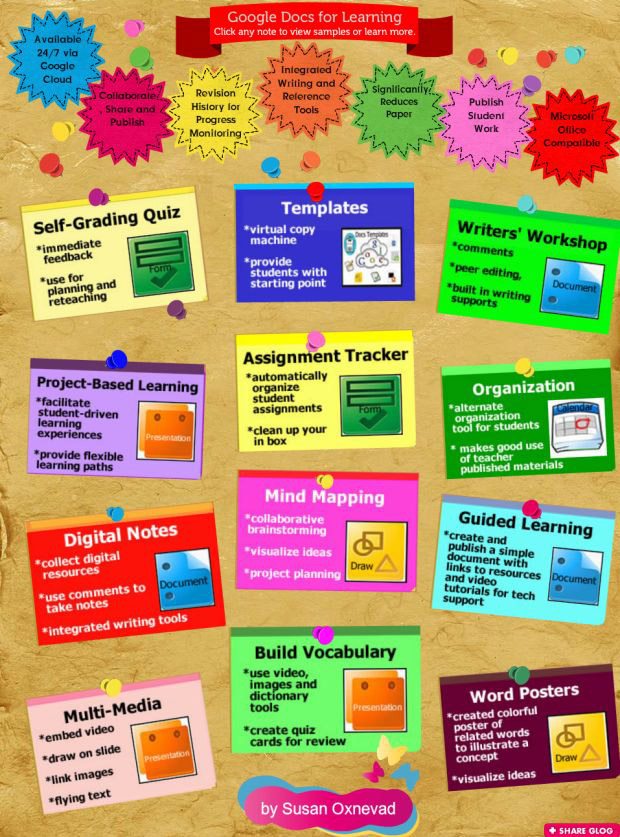
The graphic below gives 12 different ways a teacher can use Google Drive in the classroom. I love the idea of using Google Drive for rubrics (create a form, answer the questions to assess a writing piece, then all answers are automatically stored in a handy spreadsheet that Google automatically creates for you - aka AMAZING!).
5. How? (Basic instructions)
You can find a starter guide for Google Drive here. I am also available to give you a tutorial at your convenience - simply fill out a Technology Coach Request form on my website (https://sites.google.com/site/reestechcenter/teacher-technology-center-requests). I used Google Drive to create my website, request forms, and even this blog! Needless to say, I am a big fan and continually amazed by the possibilities with Google.
In closing, I will leave you with this little video to peak your interest and get you pumped up about collaboration with Google Drive:
Thanks for reading, and have a wonderful Thanksgiving break. I know I am QUITE thankful for this wonderful opportunity to be the Technology Coach at River Eves Elementary, an incredible school!
1. What? (A brief overview of what the app does) Evernote allows you to keep track of information in any environment using whatever device you find most convenient (phone, iPad, computer, etc.), and makes this information accessible and searchable at any time, from anywhere. Using Evernote, you can quickly jot notes, create to-do lists, clip entire Web pages, manage passwords, record audio, and take pictures. Everything added to Evernote is automatically updated on all devices and even searchable. Currently, I use it on my computer, iPad, and iPhone - it's easy and amazing!
2. Who? (Audience, which grade levels can really
benefit from this app)
Everyone can benefit from Evernote! In the classroom, Evernote would be great for keeping track of behavior concerns, RTI information, even a Writing Portfolio ("notebooks" in Evernote can be shared with the public or with individuals).
3. Where? (In what learning
context would this app be relevant?)
Every teacher can easily download this app on his or her iPad (and/or phone) and keep it for quick reference. I created a mock RTI notebook in my account to take notes on behavior, snap a quick shot of student work, record a seating chart, anything that can serve as evidence. Each notebook can be private and only visible to you as well.
(Mock RTI folder with student names and notes)
In conjunction with Penultimate (an app that is already installed on the student iPads), the iPad becomes a piece of paper upon which a student can draw pictures, write sentences, etc. These can easily be saved to your account, and you easily have assignments without printing anything!
(Penultimate folder shows student work that is drawn or written like a piece of paper)
(Penultimate writing assignment that includes teacher feedback using an easy recorded response.
Then, this can be shared with parents!)
4. Why? (How can this REALLY help
me?)
As a teacher, I always had trouble keeping track of those little pieces of paper where I would jot behavior notes, concerns, papers that indicated a weakness that should be addressed. Now, with Evernote, all this information is easily stored and accessible. Plus, as a writing portfolio, both teachers and parents can have access to student work from anywhere! Pretty amazing!
(Mock writing portfolio that can be shared with public or individuals)
5. How? (Basic instructions)
You can find information on how to get started using Evernote here. I am also available to give you a tutorial at your convenience - simply fill out
a Technology Coach Request form on my website. It really is amazing, and a great way to lose the post-its and little scraps of paper, and get digital!
In closing, I will leave you with a video to show you a little about Evernote in the classroom. Thanks for reading, and good luck with Evernote!
To review this app (and all apps in the future), I will give this App the "FRAGALE 5."
1. What? (A brief overview of what the app does)
Creates interactive presentations for students - teacher controls from iPad, student follows along on device or computer.
2. Who? (Audience, which grade levels can really benefit from this app)
Really all grade levels can use this - particularly good for quick, easy formative assessment.
3. Where? (In what learning context would this app be relevant?)
This app would probably work best in a learning center classroom - students rotate through activities and this app could give the teacher the possibility of being wireless while controlling what students see on theirs screens.
4. Why? (How can this REALLY help me?)
As a teacher, I always struggled with the formative assessment and really keeping track of my data. Nearpod takes the stress away as students track their answers in the device or computer and results are then sent to the teacher. Fun for students while teacher does not have to grade all of those "Tickets out the door."
5. How? (Basic instructions)
You can find a starter guide for Nearpod here. I am also available to give you a tutorial at your convenience - simply fill out a Technology Coach Request form on my website (https://sites.google.com/site/reestechcenter/teacher-technology-center-requests). At the end of the month, I will be holding my inaugural Friday Focus Breakfast where I will be going into more detail on Nearpod. More information to follow concerning this, but I sure am excited!
In closing, I will leave you with this little video to peak your interest and get you pumped up about Nearpod:
Thank you for visiting the River Eves Elementary School Technology Coach's Corner! Please stop by frequently as I will use this space to review apps and web-related resources. If you have any questions or concerns, you may use the "Technology Coach Request" form on my website, or simply email me, Lizzie Fragale, at Fragale@fultonschools.org.
"AS EDUCATORS WE SHOULD HELP FACILITATE GOALS AND HELP CAST A VISION FOR STUDENTS THAT WILL, NOT ONLY, STRETCH THEIR IMAGINATIONS, BUT ALSO THEIR BELIEFS REGARDING WHAT IS POSSIBLE…" - Sam Pabon